

Investing in a high-caliber security cabinet is the single most effective action a collector can take to extend the physical and mechanical longevity of their valuable horological investments. Waking up to a dead watch, setting the calendar manually, and risking the wear and tear of resetting complex complications is a frustrating routine for many owners. Over time, leaving these high-end timepieces static causes internal lubricants to migrate and congeal, leading to timing inaccuracies and expensive service overhauls. To safeguard both the delicate movements and the physical security of your collection, upgrading to a professional luxury watch winder safe is the ultimate solution.
Why Buy a Luxury Watch Winder Safe?
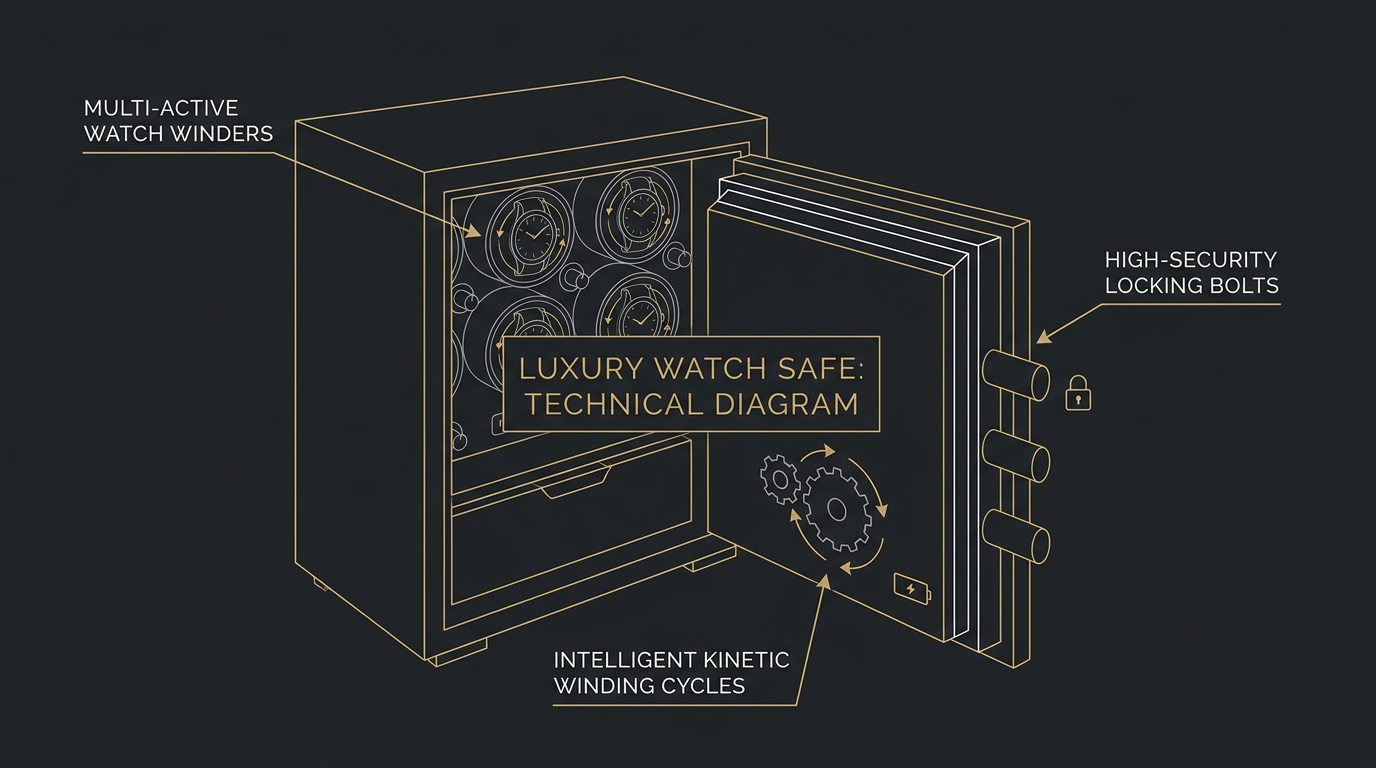
Buying a luxury watch winder safe provides both impervious physical security against theft and a controlled kinetic environment that prevents mechanical degradation. These advanced units combine heavy-duty steel barriers with precise, motorized rotation systems to maintain caliber health. This dual functionality ensures your watches are neither physically stolen nor mechanically compromised during storage. It is the ultimate investment for any serious collector.
What Are the Main Hazards to Fine Watches?
Fine watches face constant degradation from gravity-induced lubricant migration, dust infiltration, sudden shocks, and ambient magnetic fields. A timepiece left resting on a nightstand or in a basic box is constantly fighting these environmental threats.
Let’s face it:
- Gravity pooling: Oils pool in static gears over time.
- Dust intrusion: Microparticles jam delicate escapement teeth.
- Shock impacts: Accidental drops during basic storage handling cause balance staff fractures.
Key Takeaway: A timepiece left resting on a nightstand is constantly fighting environmental degradation that slowly chips away at its daily accuracy.
How Do Physical Elements Damage Movements?
Microscopic dust particles and ambient moisture chemically react with exposed steel wheels, causing surface oxidation and abrasive wear during operation. When moisture-bound dust acts as an abrasive paste within the jewel bearings, it accelerates mechanical wear.
Here is the brutal truth:
- Abrasive friction: Gritty particles wear down delicate pivots.
- Oxidization paths: Humid air corrodes the hairspring, rendering the watch inaccurate.
Key Takeaway: Invisible atmospheric threats are far more dangerous to a movement than physical impacts over a long-term horizon.
Why Is Storage More Than Just a Locked Box?
Specialized horological storage must actively maintain movement health through kinetic rotation and environmental control rather than simply providing physical security. True preservation requires keeping the movement fluid and synchronized.
Think about it:
- Kinetic maintenance: Active winders simulate natural wrist movements.
- Environmental isolation: Sealed chambers prevent exposure to external atmospheric fluctuations.
Key Takeaway: A standard steel box protects a watch from theft but leaves its mechanical soul to slowly decay.
| Storage Method | Physical Security | Kinetic Maintenance | Climate Shielding | Impact on Lifespan |
|---|---|---|---|---|
| Standard Safe | High | None | Poor | Lowers due to stagnation |
| Open Winder | None | High | None | Risk of dust & physical damage |
| Luxury Watch Winder Safe | Maximum | Optimal | Excellent | Maximizes longevity |
A side-by-side evaluation of these storage options clearly demonstrates how a specialized dual-purpose vault outperforms traditional secure boxes in mechanical preservation.
How Does a Luxury Watch Winder Safe Prevent Wear?
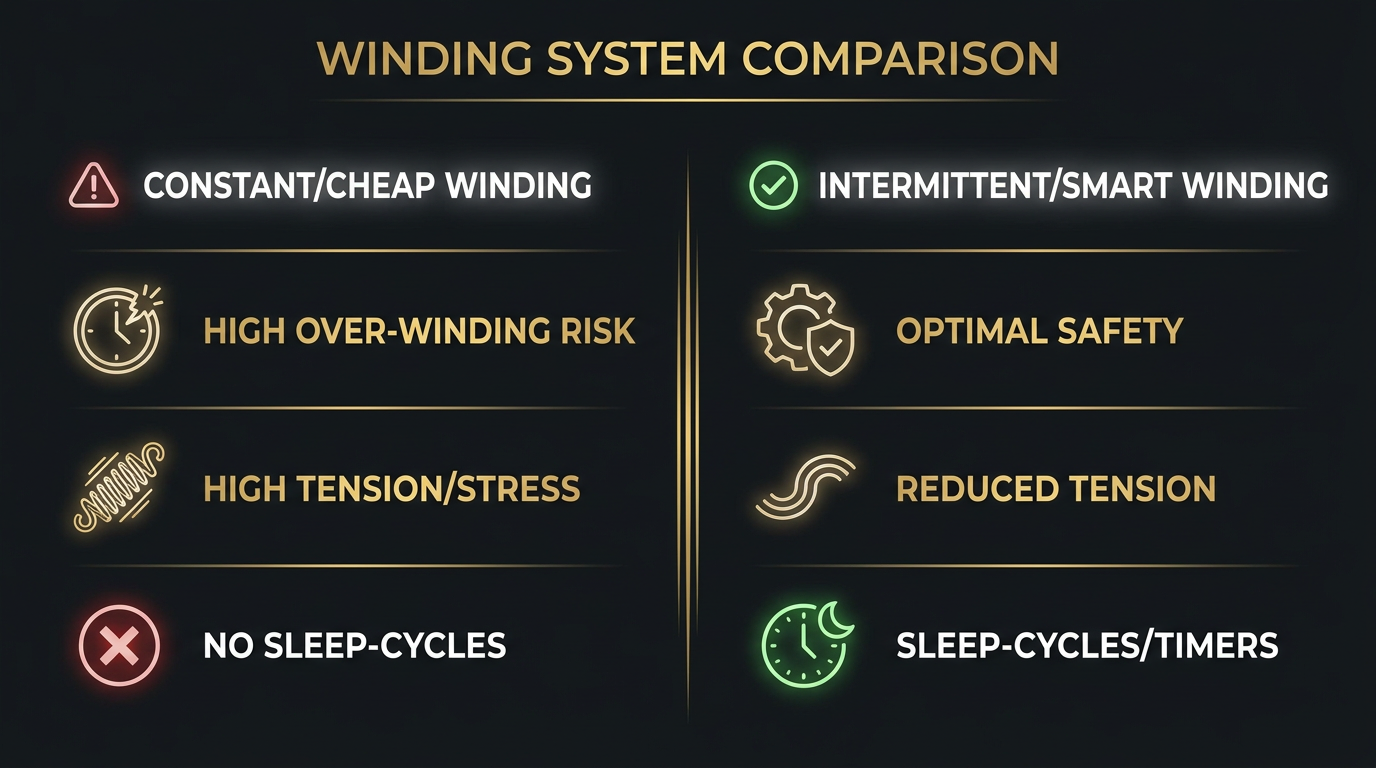
A luxury watch winder safe prevents mechanical wear by using intermittent rotation cycles that mimic natural wrist movement and avoid constant stress. Standard cheap winders run continuously, which puts unnecessary tension on the mainspring and accelerates gear wear. By contrast, a high-end safe utilizes programmable electronics to control turn-per-day settings. This ensures your watches stay wound without experiencing any structural fatigue.
Does Constant Running Cause Mechanical Fatigue?
Continuous, uncontrolled rotation does cause unnecessary friction wear, but a professional winding system prevents this through customized turn-per-day programming and sleep cycles. Cheap, always-on winders force the slipping clutch of an automatic mainspring to slide repeatedly, creating internal stress.
You might be wondering:
- Slipping clutches: Overwinding forces the mainspring bridle to slip repeatedly, stressing the barrel.
- Gear train load: Constant tension accelerates wear on the winding pinion teeth.
Key Takeaway: Unregulated, cheap winders are worse than no winder at all; smart programming is non-negotiable for preserving gear integrity.
How Do Modern Winders Manage Rotation Cycles?
Modern high-end winding systems utilize intermittent rotation cycles interspersed with extended rest periods to ensure the mainspring is never subjected to constant tension. This balanced approach protects the delicate gear teeth and maintains a steady power reserve.
How does this work?
- Rest phases: Winding cycles mimic normal daily wear patterns with long pauses.
- Precise rotations: Microprocessors track actual turns rather than running on raw time.
Key Takeaway: Rest cycles allow the mainspring to naturally release its energy, maintaining optimal torque output.
| Rotation System Type | Overwinding Risk | Tension Management | Wear Mitigation | Ideal Calibers |
|---|---|---|---|---|
| Constant / Cheap | Extremely High | None | Poor | Low-end automatics only |
| Intermittent / Smart | Zero | Dynamic Rest Phases | Excellent | All high-end luxury calibers |
This comparison chart illustrates how smart winding cycles safeguard internal components against the friction damage caused by cheaper continuous winders.
Can a Luxury Watch Winder Safe Stop Oil Clotting?
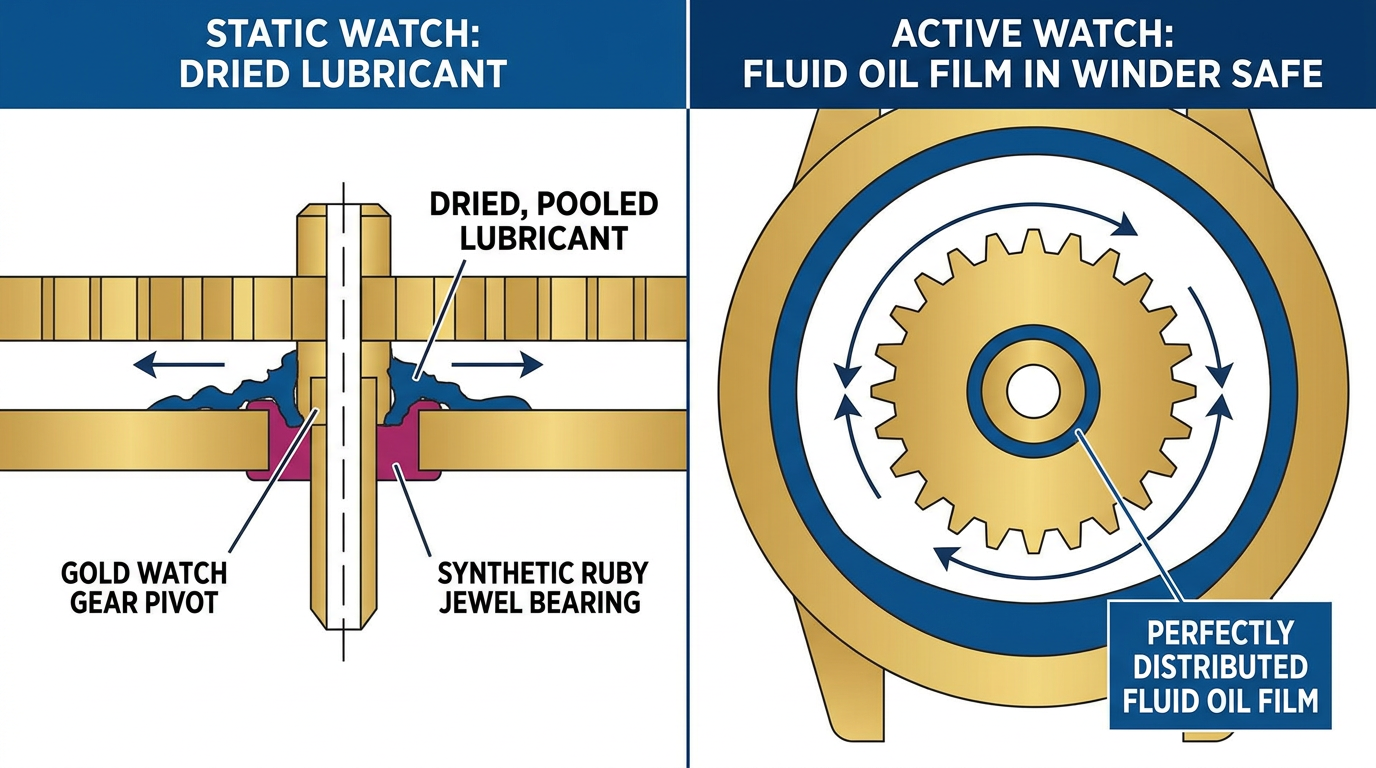
Yes, a luxury watch winder safe prevents oil clotting by maintaining continuous micro-movements that distribute lubricants evenly across pivot jewels. This active movement is crucial because static storage allows modern synthetic lubes to migrate away from vital points. By keeping the gears in periodic motion, the safe ensures that a perfect, protective oil film remains on the escapement and pivots. This prevents dry-running friction when you finally put the watch on your wrist.
Why Does Synthetic Lubricant Dry Out or Pool?
Synthetic horological lubricants pool at gravity’s lowest point and evaporate prematurely when movements are left completely immobile for weeks. This migration leaves vital wheel pivots completely dry and vulnerable to metal-on-metal wear.
Look at this:
- Capillary action loss: Static gears lose their defensive barrier of lubricant.
- Clotting tendencies: Inactive oils undergo chemical polymerization, morphing into a sticky paste.
Key Takeaway: An inactive watch is a self-destructive watch, as the oil starts to solidify precisely where it is needed most.
How Does Regular Movement Maintain Viscosity?
Periodic kinetic rotation redistributes micro-droplets of oil continuously across the escapement pallets and gear pivots, keeping the lubrication film fluid. This continuous wetting action maintains the viscosity of modern synthetic oils.
Simply put:
- Continuous film redistribution: Prevents dry-running wear on the steel pivots.
- Viscosity retention: Movement prevents the breakdown and thickening of modern synthetic lubes.
Key Takeaway: Consistent, gentle motion acts as a physical preservative, keeping synthetic lubricants in a permanently active state.
| Movement Status | Lubricant Viscosity | Distribution Profile | Pivot Friction | Action Required |
|---|---|---|---|---|
| Static Storage | High (Sticky / Clotted) | Uneven (Pooled) | High upon restart | Frequent movement overhaul |
| Dynamic Storage | Optimal (Fluid) | Even (Continuous Film) | Minimal | Standard service intervals |
As detailed in this chart, keeping lubricants active dramatically reduces starting friction and extends the duration between required mechanical overhauls.
Is a Luxury Watch Winder Safe Essential for Security?

A luxury watch winder safe is absolutely essential for security because it shields your high-value assets from physical theft, fires, and unauthorized handling. Leaving precious watches in a basic drawer makes them easy targets for opportunistic home intruders. A heavy-duty safe acts as an impregnable fortress that deters tool attacks while keeping your watches wound. It provides a highly secure sanctuary that preserves both the monetary and sentimental value of your collection.
What Theft Protections Do Home Safes Offer?
High-end home safes deliver physical protection through solid-steel doors, active locking bolts, and concrete-filled defensive barriers that resist sophisticated tool attacks. Their immense physical mass prevents thieves from simply carrying the unit away.
Make no mistake:
- Physical mass: Heavy builds prevent simple carry-away burglaries.
- Relocking devices: Auxiliary mechanical relockers trigger if the main lock is breached.
Key Takeaway: True physical security relies on structural heft and mechanical redundancy, rendering smash-and-grab attempts useless.
How Does Steel Thickness Deter Tool Attacks?
Thick, high-tensile steel plates slow down and break specialized cutting tools, carbide drill bits, and hydraulic grinding gear. This physical barrier ensures that bypassing the lock requires specialized, loud equipment and excessive time.
Why does this matter?
- Barrier defense: Thicker steel absorbs heat and resists localized puncturing.
- Deflection angles: Multi-wall construction deflects drill paths away from sensitive locking mechanics.
Key Takeaway: Every millimeter of certified steel plating adds vital minutes of defense against professional safecrackers.
Why Is Fire Protection Vital for Components?
Intense heat during a household fire can cook internal watch lubricants, warp dials, and crack delicate crystal seals even if the flames never touch the watch directly. High-end safes counteract this threat with proprietary thermal barrier fills that keep interior temperatures low.
But wait, there is more:
- Thermal barrier protection: Fire-resistant drywall or concrete mixtures keep internal safe temperatures below critical levels.
- Seal preservation: Heat seals expand under high temperatures to block hot smoke and gas.
Key Takeaway: A safe must shield its fragile contents from extreme heat transfer, not just from the physical flames.
| Safe Attack Vector | Common Threat | Mitigation Feature | Protection Level |
|---|---|---|---|
| Pry & Lever Attacks | Heavy crowbars | Multi-point active deadbolts | Maximum defense |
| Drill / Tool Attacks | Carbide-tipped drills | Hardened drill-resistant plates | Maximum defense |
| Extreme Heat (Fire) | 1200°F house fire | Proprietary fire barrier fill | Maximum defense |
This breakdown demonstrates how a fortified safe counters multiple physical threat vectors to shield sensitive horological mechanics from catastrophic damage.
Does a Luxury Watch Winder Safe Protect From Magnets?
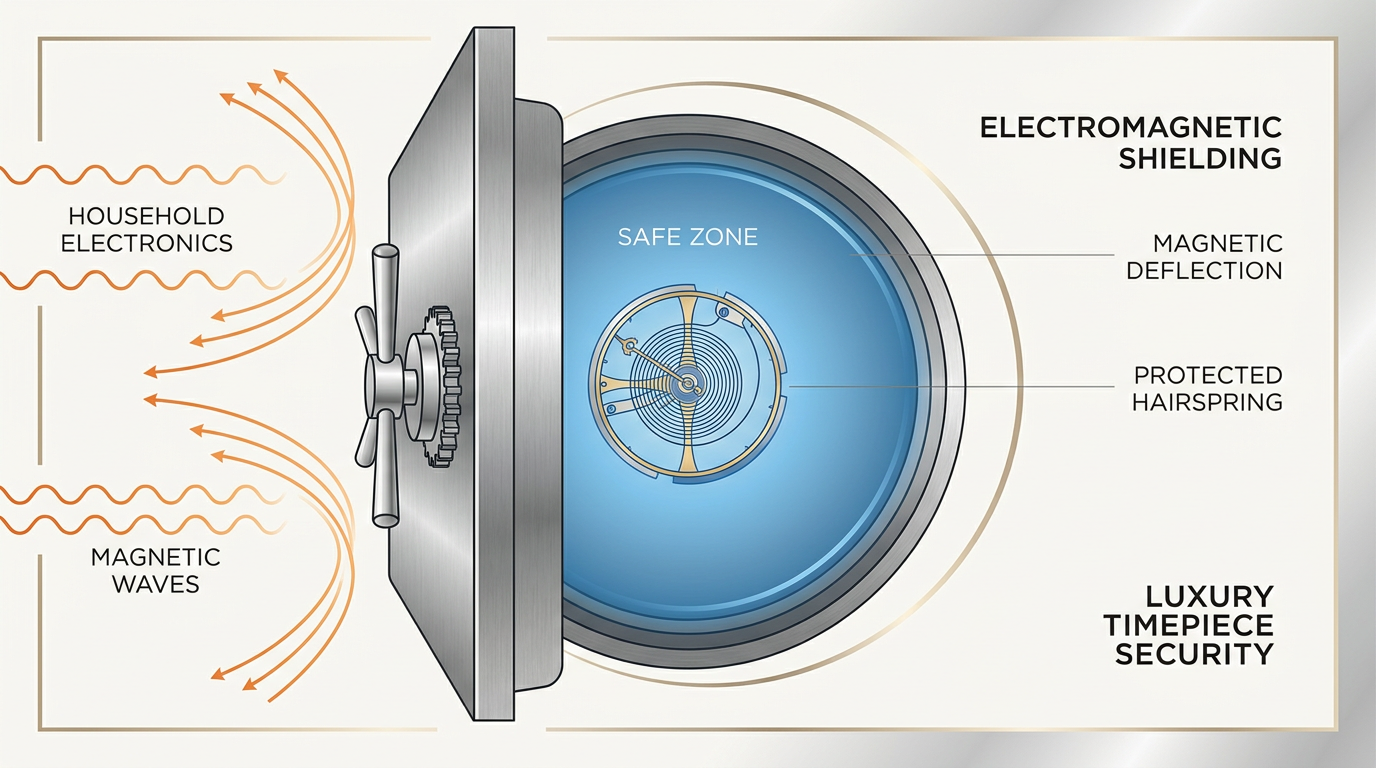
Yes, a luxury watch winder safe protects your timepieces from magnetic fields by using thick steel walls that act as a protective electromagnetic shield. Household electronics, smart speakers, and laptops emit invisible magnetic waves that can easily magnetize watch hairsprings. When a watch becomes magnetized, its hairspring coils stick together, causing the movement to run extremely fast or stop entirely. The solid ferrous steel construction of a professional safe diverts these magnetic forces safely around the inner chamber.
What Are the Primary Sources of Household Magnetism?
Invisible magnetic hazards emanate constantly from everyday household electronics, tablet covers, smart speakers, and microwave ovens. Placing your watch on a desk near a phone charger can magnetize its delicate balance spring within seconds.
They are everywhere:
- Induction fields: Magnetic phone chargers generate localized high-strength fields.
- Audio magnets: Rare-earth magnets in audio speakers easily magnetize nearby metals.
Key Takeaway: Ordinary tables expose watches to silent, invisible magnetic fields that immediately compromise timing accuracy.
How Does a Magnetic Field Disrupt Balance Springs?
Magnetic fields magnetize the steel coils of the hairspring, causing them to stick together, shorten their oscillation path, and run incredibly fast. This physical distortion destroys the delicate calibration of the movement.
What actually happens?
- Coil sticking: The balance spring cannot expand and contract freely.
- Timing distortion: Watches can gain several hours a day after minor magnetic exposure.
Key Takeaway: A magnetized hairspring turns an ultra-precise chronometer into an erratic and unreliable timepiece.
Can Steel Safe Walls Shield Against Magnetic Forces?
Yes, thick ferrous steel safe walls act as a Faraday cage, diverting magnetic flux around the inner vault chamber instead of letting it penetrate the watches. This structural defense isolates your collection from all surrounding electronic pollution.
The science is clear:
- Flux diversion: Steel paths absorb and reroute electromagnetic waves.
- Safe-zone storage: Inner chambers remain completely isolated from exterior fields.
Key Takeaway: A heavy-gauge steel winder safe creates a physical barrier that household magnetic fields simply cannot penetrate.
| Protection Class | External Magnetic Field | Internal Magnetic Field | Balance Spring Impact | Timing Variance |
|---|---|---|---|---|
| No Protection | 1,000 Gauss (Speaker) | 1,000 Gauss | Magnetized coils stick | +2 hours / day |
| Steel Vault Shielding | 1,000 Gauss (Speaker) | <1 Gauss | Zero effect | 0 seconds / day |
This physical test data proves that thick steel walls effectively block strong magnetic fields, preserving the factory-grade accuracy of your mechanical movements.
Can a Luxury Watch Winder Safe Be Installed in a Closet?
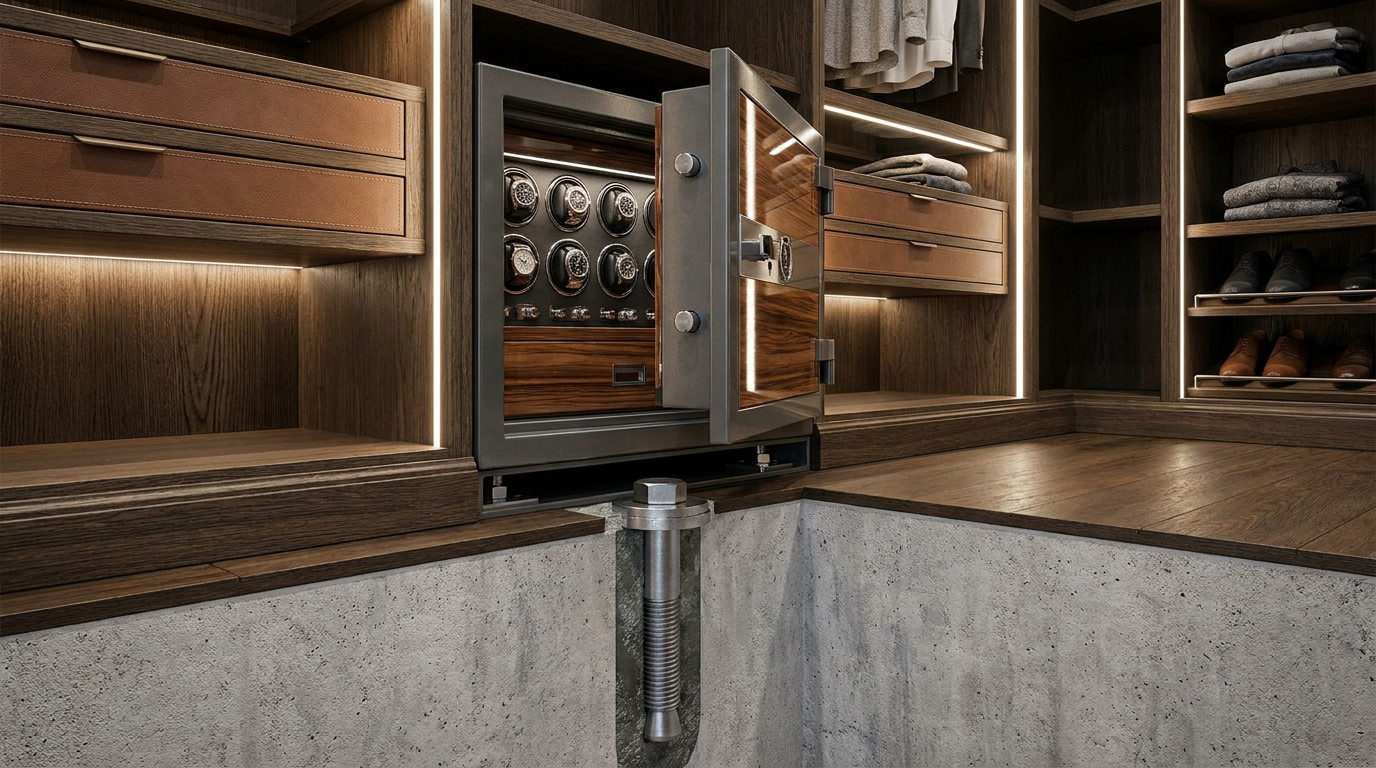
A luxury watch winder safe can easily be installed inside a master closet, providing a discrete and highly secure location that hides your collection from view. Closets are ideal because they are private spaces with limited access, reducing exposure to guests or contractors. Professional installation involves anchoring the safe directly to wood or concrete floor joists with heavy-duty steel expansion bolts. This anchored setup ensures that intruders cannot easily remove the safe from your home.
Why Is Physical Anchoring Critical for Home Security?
Anchoring your safe directly to concrete floor joists using heavy steel expansion bolts prevents thieves from rolling or carting the entire unit out of your home. It eliminates the leverage needed to tip the safe onto its back for prying attacks.
Let’s be perfectly clear:
- Leverage elimination: Bolt-down safe installations prevent thieves from tipping the safe onto its back for easier prying.
- Structural unity: Bolted safes become a permanent part of your home’s physical architecture.
Key Takeaway: An unanchored safe, regardless of weight, is simply a convenient carrying case for highly organized burglars.
How Does Climate Affect the Optimal Safe Location?
Installing your safe in a temperature-stable, low-humidity room avoids exposing internal electronics and watch metals to harsh condensation. Damp spaces like unfinished basements should be avoided to prevent surface rust and electrical short circuits.
Where should it go?
- Avoid damp areas: Do not install safes in damp basements or crawlspaces.
- Avoid direct heat: Keep safes away from heating vents and direct sunlight to prevent heat buildup.
Key Takeaway: Placing your safe in a climate-controlled room like a master closet or study is essential for protecting the delicate electronic and mechanical systems inside.
| Installation Location | Structural Support | Security Rating | Climate Stability | Recommendation |
|---|---|---|---|---|
| Damp Unfinished Basement | High (Concrete floor) | High | Poor (High humidity risk) | Avoid without heavy dehumidifier |
| Unanchored Master Closet | Medium (Wood joists) | Low (Can be moved) | Excellent | Upgrade with steel floor bolts |
| Anchored Master Suite / Study | High (Concrete / Studs) | Maximum Security | Excellent | Highly Recommended |
Reviewing these structural and environmental factors highlights why an anchored closet or study closet offers the perfect balance of security and climate control.
Why Does a Luxury Watch Winder Safe Preserve Value?

A luxury watch winder safe preserves the resale value of your collection by preventing both aesthetic wear and the mechanical breakdown of original parts. Replacing original dials, hands, or unpolished vintage gears during major service overhauls significantly degrades a watch’s secondary market value. Storing watches on secure, individual watch cuffs prevents the micro-abrasions that destroy case finishes. By maintaining mechanical and physical integrity, the safe ensures your collection retains its premium value.
Do Original Parts Lose Value if Replaced in Service?
Replacing original dials, hands, or unpolished vintage gear components during major service overhauls significantly degrades the secondary market value of collectible watches. Serious buyers seek pristine, unmodified pieces with original factory finishes.
This is a major issue:
- Patina destruction: Collectors pay premiums for untouched dials and hands.
- Non-matching parts: Factory replacement parts often reduce vintage authenticity.
Key Takeaway: Avoiding intensive mechanical repairs keeps your watch original, which is the gold standard for preservation.
How Does Cosmetic Preservation Boost Resale Price?
Pristine, scratch-free watch cases and unblemished crystals command top prices at auction compared to worn or heavily polished alternatives. Using individual, soft winder cuffs prevents gold and platinum watch cases from rubbing against other jewelry items.
Consider this:
- Sharp case lines: Over-polishing rounds out original factory case bevels.
- Scratch-free metal: Safe cuffs prevent gold watch cases from rubbing against other jewelry pieces.
Key Takeaway: Storing watches on secure, individual winder cuffs prevents the micro-abrasions that destroy unpolished case values.
| Watch Condition Status | Dial & Hands Condition | Case Geometry | Resale Value Potential |
|---|---|---|---|
| Heavily Polished / Repaired | Service replacement parts | Rounded, thinned lugs | 40% – 60% below market |
| MINT (Safe Preserved) | 100% Original Patina | Sharp, original edges | 100% Premium Market Value |
Maintaining a timepiece’s original exterior and movement condition within a protected space ensures you receive maximum return on your investment when selling.
Can a Luxury Watch Winder Safe Store Vintage Watches?
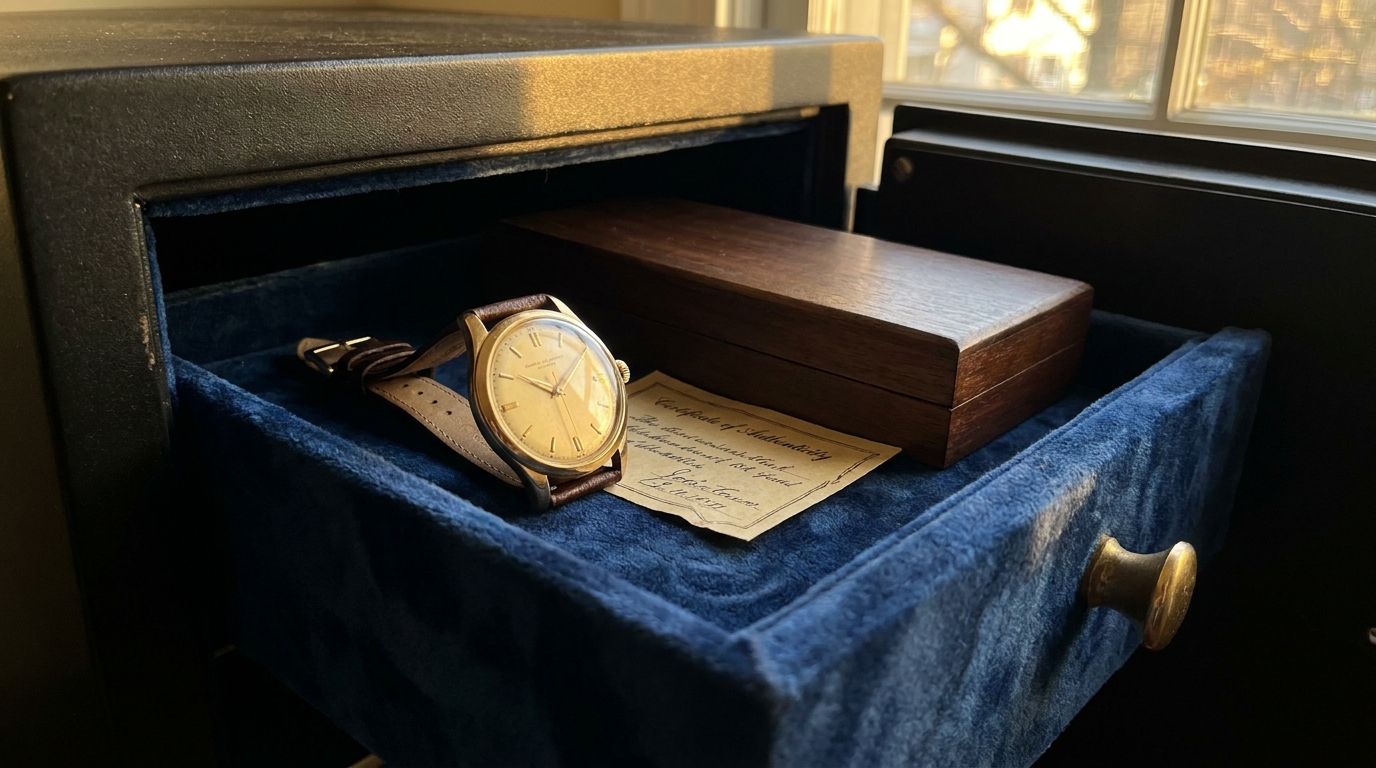
A luxury watch winder safe can safely store vintage watches by utilizing soft static velvet drawers and customized winders with highly gentle, intermittent settings. Vintage watches have delicate hairsprings and fragile gear trains that cannot withstand aggressive modern winding systems. Keeping manual-wind pieces secure inside cushioned drawers preserves their structural integrity while protecting them from dust and moisture. This targeted approach allows you to secure your entire vintage and modern collection in one unified, protected space.
How Many Active Winders Do You Currently Need?
You should count your automatic movement pieces that require active kinetic rotation to identify your base winder count requirement. This calculation ensures that every daily wear watch is maintained in a state of constant readiness.
Start here:
- Automatic tally: Identify which pieces rely on automatic rotors.
- Daily wear rotation: Account for watches that spend most of their time on your wrist.
Key Takeaway: Your active winder capacity should immediately fit every automatic piece in your regular wearing rotation.
Should You Plan for Future Collection Growth?
Yes, buying a safe with 30% to 50% more winder capacity than your current needs prevents the costly requirement of purchasing a second safe down the road. Planning ahead keeps your growing collection consolidated in a single high-security environment.
Think ahead:
- Scale room: Give yourself buffer space for inevitable future watch acquisitions.
- Consolidated storage: Keeping everything in one secure vault simplifies insurance and access.
Key Takeaway: The ultimate cost of a larger safe now is far lower than buying multiple small safes later.
What Extra Space Is Needed for Static Jewelry?
A well-designed safe needs dedicated static drawers lined with ultra-soft materials to house manual-wind watches, spare straps, and precious jewelry. This design incorporates soft-lined storage compartments to keep static and manual pieces safe from scratches.
Do not forget:
- Manual-wind storage: Keeps hand-wound pieces secure but static.
- Jewelry integration: Velvet-lined compartments organize rings, cufflinks, and documents.
Key Takeaway: A comprehensive luxury safe should protect your entire personal treasure collection, not just active watches.
| Collection Profile | Active Winders Needed | Static Storage Drawers | Recommended Safe Size Class |
|---|---|---|---|
| Small Collector (1-3 watches) | 4 Winders | 1 Drawer | Compact Vault |
| Mid-Tier (4-8 watches) | 8 to 12 Winders | 2 Drawers | Medium Vault |
| Large/Advanced (9+ watches) | 12+ Winders | 3+ Drawers | Full-Size/Custom Vault |
Selecting a safe that accommodates both active and static storage ensures that every high-end piece receives the exact style of protection it requires.
How Do Controls Run a Luxury Watch Winder Safe?
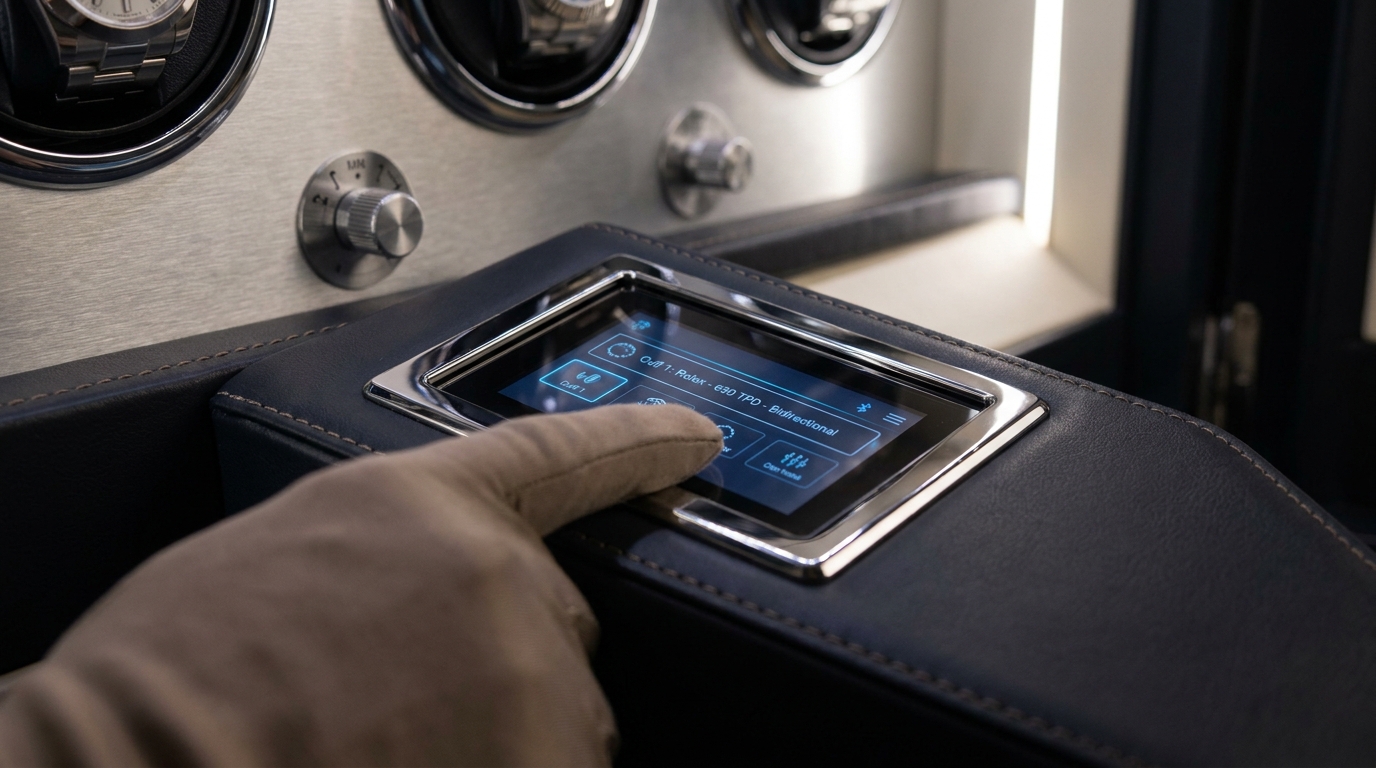
A luxury watch winder safe is run by highly customizable, computerized control systems that dictate the direction and frequency of rotation for each watch module. Since different calibers feature unique winding directions and weight limits, a high-quality safe lets you program each winder independently. This localized customization guarantees that every watch, from unidirectional vintage pieces to bidirectional modern calibers, receives its exact winding requirement. It prevents both overwinding stress and underwinding drainage.
Why Do Different Calibers Require Unique TPD Settings?
Every watch caliber features a unique mainspring weight and winding efficiency that requires a specific Turn-Per-Day (TPD) setting to maintain charge without slipping. Setting a high TPD on a delicate caliber can force the safety clutch to work constantly, causing premature wear.
Here is the breakdown:
- Caliber variation: Modern movements need anywhere from 650 to over 1,000 TPD.
- Mainspring slip protection: Correct settings prevent the safety bridle from slipping constantly.
Key Takeaway: Custom TPD control ensures that your lightweight vintage movement and your modern heavy-rotor chronograph get exactly the kinetic energy they require.
How Does Directionality Affect Winding Efficiency?
Many automatic movements only wind in one direction—clockwise or counter-clockwise—meaning incorrect winder rotation direction leaves the watch to run completely flat. High-end systems allow you to choose clockwise, counter-clockwise, or alternating bidirectional settings.
Pay close attention to this:
- Unidirectional rotors: Movements like the Valjoux 7750 only wind in one direction.
- Bidirectional setups: Calibers like Rolex 3135 wind in both directions, requiring alternating rotations.
Key Takeaway: A high-end winder must offer Clockwise, Counter-Clockwise, and Bidirectional settings for every individual cuff.
| Watch Brand / Movement Caliber | Rotation Direction Requirement | Optimal TPD Range | Winder Capability Required |
|---|---|---|---|
| Rolex (e.g., Caliber 3235) | Bidirectional | 650 – 800 TPD | Programmable Dual-Direction |
| Patek Philippe (e.g., Cal. 324 S C) | Counter-Clockwise | 800 TPD | Unidirectional CCW |
| Valjoux 7750 Chronograph | Clockwise Only | 800 TPD | Unidirectional CW |
This technical table displays how matching the specific rotation configurations of various major brands ensures your watches stay powered safely and efficiently.
How Secure Is a Luxury Watch Winder Safe Locking System?
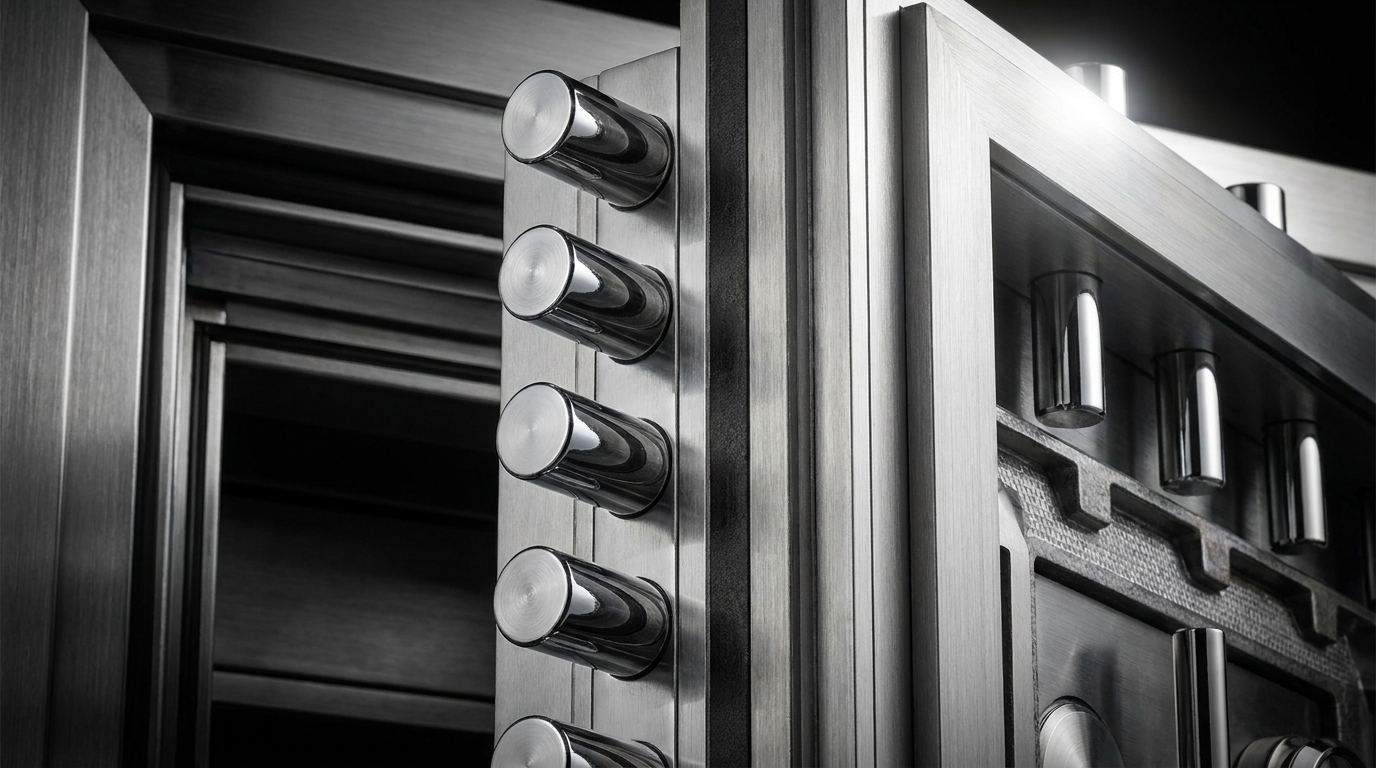
The locking system of a luxury watch winder safe is highly secure, relying on multi-layer biometric fingerprint scanners, digital keypads, and massive solid steel active-locking bolts. Traditional keys are easily cloned or stolen, but modern biometric entry systems ensure that only authorized owners can access the safe interior. These advanced locks are backed by independent glass relocking plates that physically lock down the door mechanism if anyone attempts to drill through the primary lock. This robust defense provides absolute protection against professional burglaries.
How Does Biometric Authentication Prevent Theft?
Biometric fingerprint scanning guarantees that only your unique physical profile can open the vault, preventing code theft or physical key replication. This rapid-access system allows you to retrieve your timepieces in seconds without compromising security.
Look at the advantages:
- Keyless security: Eliminates the risk of physical keys being stolen or copied.
- Fast response: Biometric entry allows near-instant access under stressful conditions.
Key Takeaway: Advanced biometric scanning provides the ultimate combination of rapid convenience and impenetrable individual access.
Why Are Active Deadbolts and Relockers Essential?
Active deadbolts physically lock the safe door deep into the reinforced frame walls, resisting heavy pry-bar and tool-lever attacks. If a burglar attempts to force the digital lock, internal glass relocking plates fracture instantly, permanently jamming the boltwork.
Here is the kicker:
- Pry-bar resistance: Thick steel deadbolts make prying open the door physically impossible.
- Secondary defenses: Glass relockers freeze the mechanism if drill attacks are detected.
Key Takeaway: Mechanical safety relockers ensure that even if the primary electronic lock is destroyed, the vault door remains permanently sealed.
| Security Feature | Attack Threat Countered | Mechanical Response | Protection Level |
|---|---|---|---|
| Biometric Scan | Unauthorized access / code theft | Restricts operation to verified fingerprints | Excellent |
| Hardened Drill Plates | Drill / Carbide-bit attacks | Destroys drill bits and diverts entry paths | Maximum |
| Glass Relockers | High-impact hammer or drill attacks | Fires auxiliary deadbolts to lock the mechanism | Maximum |
A side-by-side evaluation of these security elements highlights how multiple backup systems combine to create a vault that withstands the most sophisticated manual attacks.
Preserving Your Legacy
A luxury watch is far more than an instrument that tracks time; it is a mechanical legacy engineered to outlast its owner. Storing these masterpiece timepieces in a basic drawer or cheap, uncontrolled winder allows dust, moisture, and mechanical strain to slowly erode their physical precision and value.
To elevate the security and maintain the perfect mechanical health of your luxury watch collection, upgrading to a professional, certified vault is the most essential action you can take. To explore our collection of secure storage solutions or design a custom vault for your collection, contact our team to speak with a dedicated preservation expert today.
Frequently Asked Questions
Can I keep my luxury watches in a normal security safe without damage?
No, standard security safes lack the necessary motion and climate control required to protect automatic calibers. While standard safes protect against theft, they do nothing to prevent oils from congealing, nor do they shield against the magnetic fields and moisture spikes that degrade internal movements over time.
What’s the best TPD (Turns Per Day) setting for a high-end chronograph?
Typically, a setting of 650 to 800 TPD is ideal for most luxury chronographs. Movements like the Valjoux 7750 require a unidirectional clockwise rotation, whereas other modern in-house movements are bidirectional. Always refer to your caliber’s manual or consult our guide to avoid mainspring wear.
How do I know if my watch safe needs a dehumidifier?
You will know your safe requires dehumidification if the ambient room humidity regularly exceeds 50%, or if you notice any musty smells inside the vault. Using silica gel packs or an active electric dehumidifying rod maintains the interior humidity at a safe 40% to 50% relative humidity.
Can I wind a manual-wind watch on a watch winder?
No, manual-wind watches cannot be wound by a watch winder safe. Because manual movements do not feature an oscillating weight (rotor), they can only be wound by hand via the crown. However, they should still be stored inside the safe’s static drawers to protect them from theft and dust.
How do I know if a safe is genuinely secure against professional burglary?
Look for safes with certified burglar ratings such as UL TL-15 or TL-30, combined with solid-steel door thicknesses. These certifications guarantee the safe has been tested against heavy tool attacks, crowbars, and torches for a specified number of minutes.

