 跳到内容
跳到内容 

Watch winders enhance watch longevity by keeping the internal movement active, ensuring lubricants remain evenly distributed and reducing mechanical strain on the crown and gaskets. You invest significant capital into a luxury timepiece collection, yet allowing these mechanical marvels to sit stationary is a silent threat to their complex engineering.
When your watch remains idle for weeks, the synthetic oils designed to protect pivots can settle or migrate, creating “dry” spots that cause immediate friction damage upon restart. You deserve a solution that maintains the mechanical heartbeat of your collection while providing the ultimate layer of protection. An automatic watch winder safe solves the dilemma of mechanical stagnation by mimicking natural wrist movement within a high-security environment.

Is an automatic watch winder safe for longevity?
An automatic watch winder safe is essential for longevity because it maintains the consistent kinetic energy required to keep mainsprings under optimal tension without overstressing the movement. Your watches are designed to be in motion, and a controlled winding cycle prevents the internal “gumming up” of lubricants.
The Dynamics of Kinetic Energy
The primary function of a winder is to simulate the kinetic energy your body provides during daily wear. Think about it: a car that sits in a garage for months often has more engine issues than one driven regularly.
- Constant movement keeps the balance wheel swinging.
- Controlled rotations prevent the mainspring from fully unwinding.
- Periodic motion ensures that metal-on-metal components remain active.
Preventing Mechanical Dormancy
When a watch enters a sAtate of dormancy, the escapement and gear train are no longer engaged, which can lead to microscopic seizing over many years. You avoid the stress of “cold starts” by maintaining a baseline power reserve.
The kicker is:
Starting a watch from a dead stop requires manual winding or vigorous shaking, both of which apply more torque than a gentle winder cycle.
Key Takeaway: Consistent, low-torque rotation is the most gentle way to maintain a mechanical movement over time.
| Feature | Impact on Longevity |
|---|---|
| Rotation Cycle | Prevents oil from pooling in the gear train. |
| Power Reserve | Maintains constant amplitude for better accuracy. |
| Secure Housing | Protects against environmental dust and moisture. |
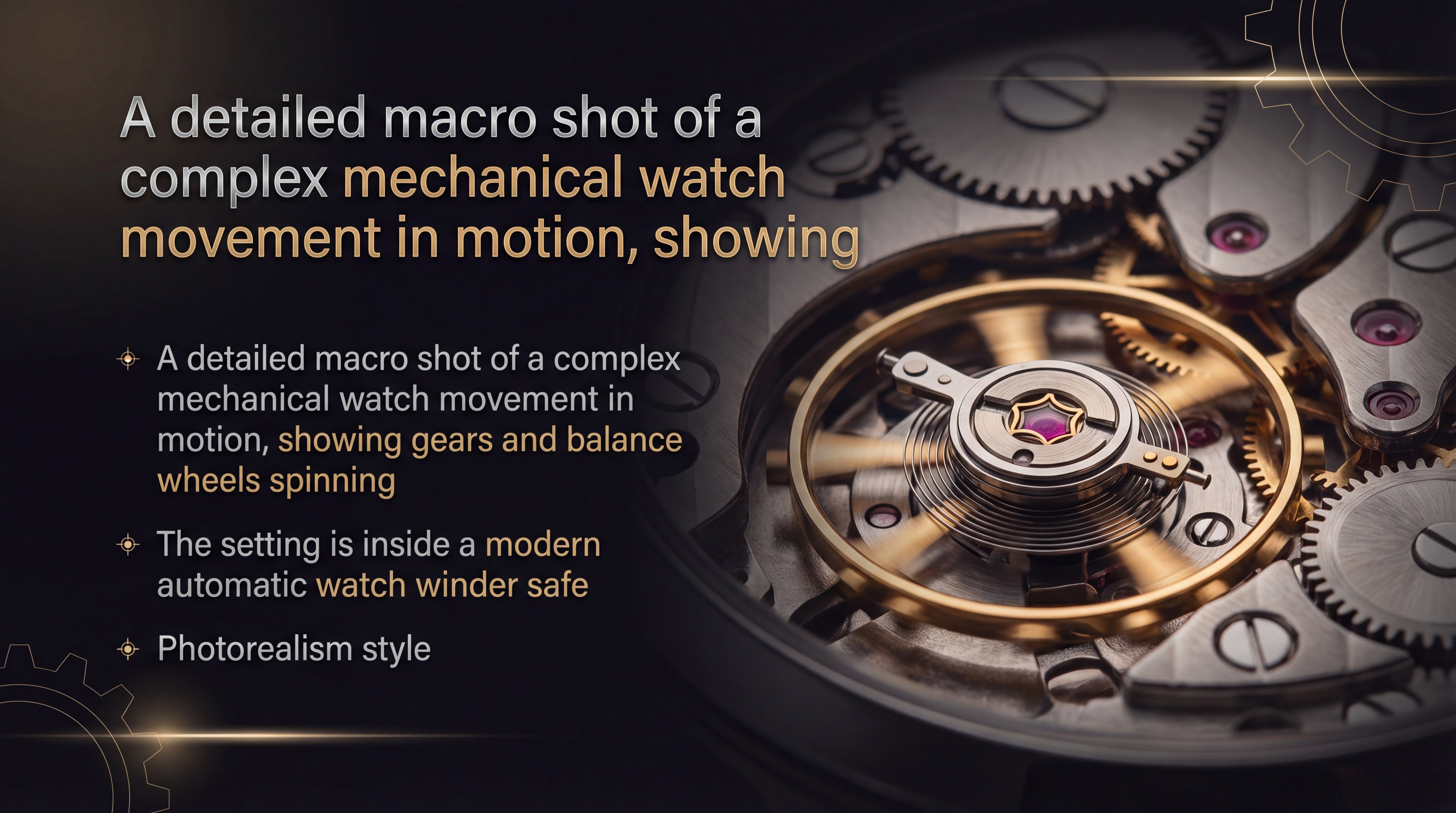
Regular movement ensures the balance wheel oscillates at its intended frequency, preserving long-term calibration.
How does an automatic watch winder safe prevent oil stagnation?
An automatic watch winder safe prevents oil stagnation by ensuring that synthetic lubricants stay evenly distributed across pivots and jewels through regular rotation. When the gear train is in motion, the centripetal force and mechanical interaction keep the oils from migrating away from high-friction contact points.
Maintaining Lubricant Viscosity
Modern watches use high-tech synthetic oils that are resistant to evaporation, but they still benefit from the agitation provided by movement. If you let a watch sit for months, gravity can pull these oils away from the escapement, leaving it vulnerable to wear.
- Motion keeps the oil film consistent on gear teeth.
- Regular cycles prevent the oils from thickening or oxidizing in place.
- Continuous engagement keeps the pallet stones properly lubricated.
Reducing Friction at Restart
Starting a watch that has been dormant for a long time can cause “scuffing” on the pivots before the oil has a chance to redistribute. You can learn how to prevent mechanical stagnation in luxury collections with a 4 watch winder safe to see how specific rotation counts matter.
Here is the deal:
By the time you notice a watch is running slow due to stagnation, the internal damage may already require a full overhaul.
Key Takeaway: Preventing oil migration is the single most effective way to delay expensive professional servicing.
| Lubrication Status | Resulting Condition | Winder Benefit |
|---|---|---|
| Stationary | Oil migration and dry pivots. | Keeps oils distributed. |
| Active (Winder) | Consistent protective film. | Reduces friction wear. |
| Stagnant | Increased torque requirements. | Maintains low-torque flow. |
Uniform lubrication across the movement reduces the friction that causes metallic particles to accumulate in the jewels.
Can an automatic watch winder safe reduce crown gear wear?
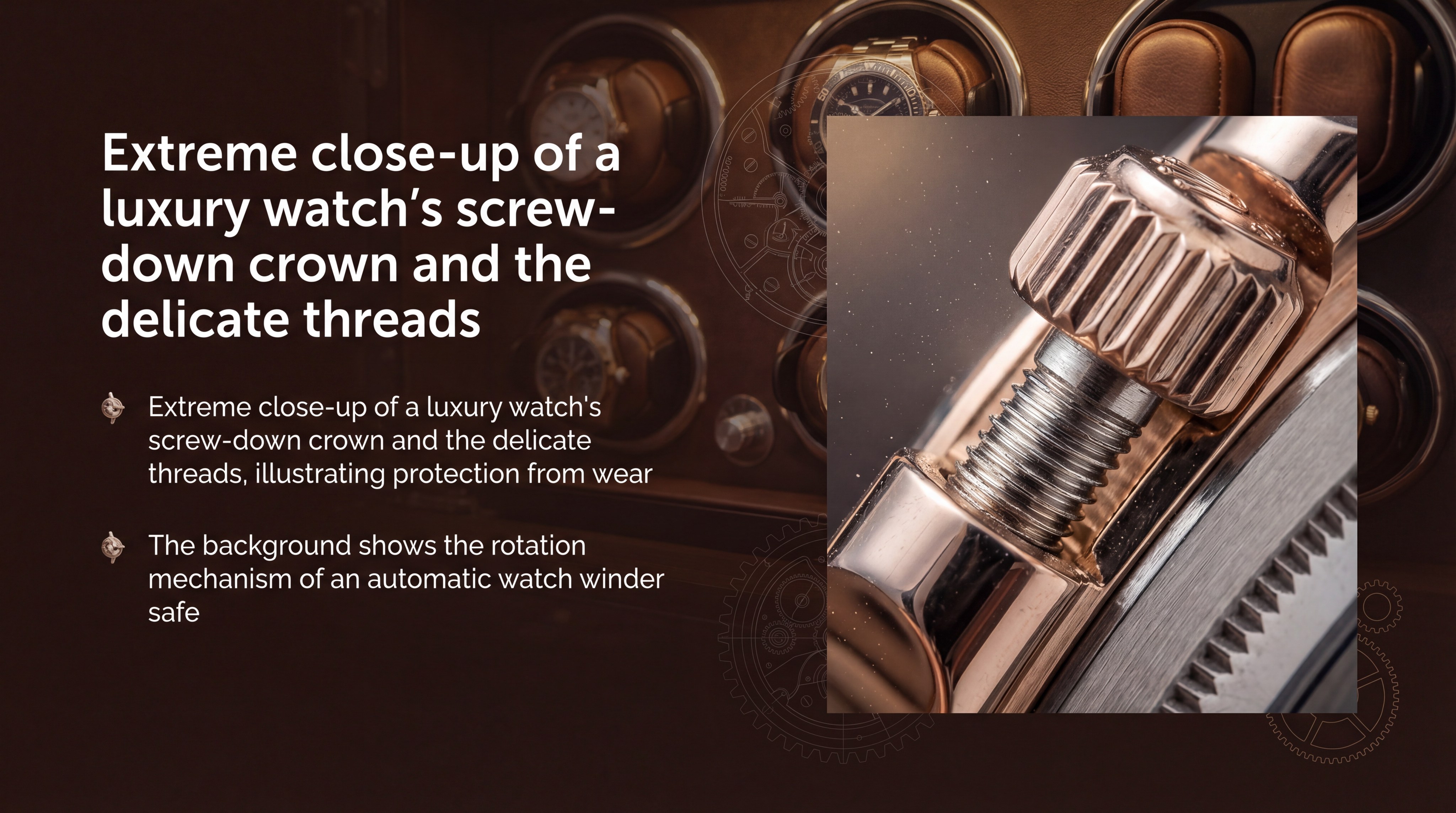
An automatic watch winder safe reduces crown gear wear by eliminating the need to manually unscrew, pull, and turn the crown to reset the time and date. The crown mechanism is one of the most fragile points of a watch, and frequent manual adjustment often leads to stripped threads or damaged stems.
Protecting the Screw-Down Mechanism
Every time you unscrew a crown to set a dormant watch, you are applying physical stress to the gaskets and the delicate threads of the crown tube. Over time, these threads can wear down or become cross-threaded, which compromises the water resistance of your timepiece.
- Winders keep the watch running so the crown remains screwed in.
- Reduced handling prevents skin oils from building up on the crown seals.
- Minimizing manual winding cycles preserves the internal winding pinion.
Minimizing Date and Time Resets
Frequent date changes, especially during the “danger zone” between 9 PM and 3 AM, can break the fragile date-flip gears. You bypass this risk entirely because your watch is always displaying the correct date and time.
Think about it:
The less you touch the crown, the longer your watch stays factory-sealed and water-resistant.
Key Takeaway: Most mechanical failures occur during manual adjustment; a winder removes this variable from your daily routine.
| Component | Manual Setting Risk | Winder Protection |
|---|---|---|
| Crown Threads | Stripping and cross-threading. | Minimal engagement required. |
| Stem | Bending or snapping under pressure. | No manual stress applied. |
| Gaskets | Friction wear and compression loss. | Seals remains undisturbed. |
Protecting the crown assembly ensures the watch remains airtight and free from microscopic debris.
Why is an automatic watch winder safe vital for calendars?
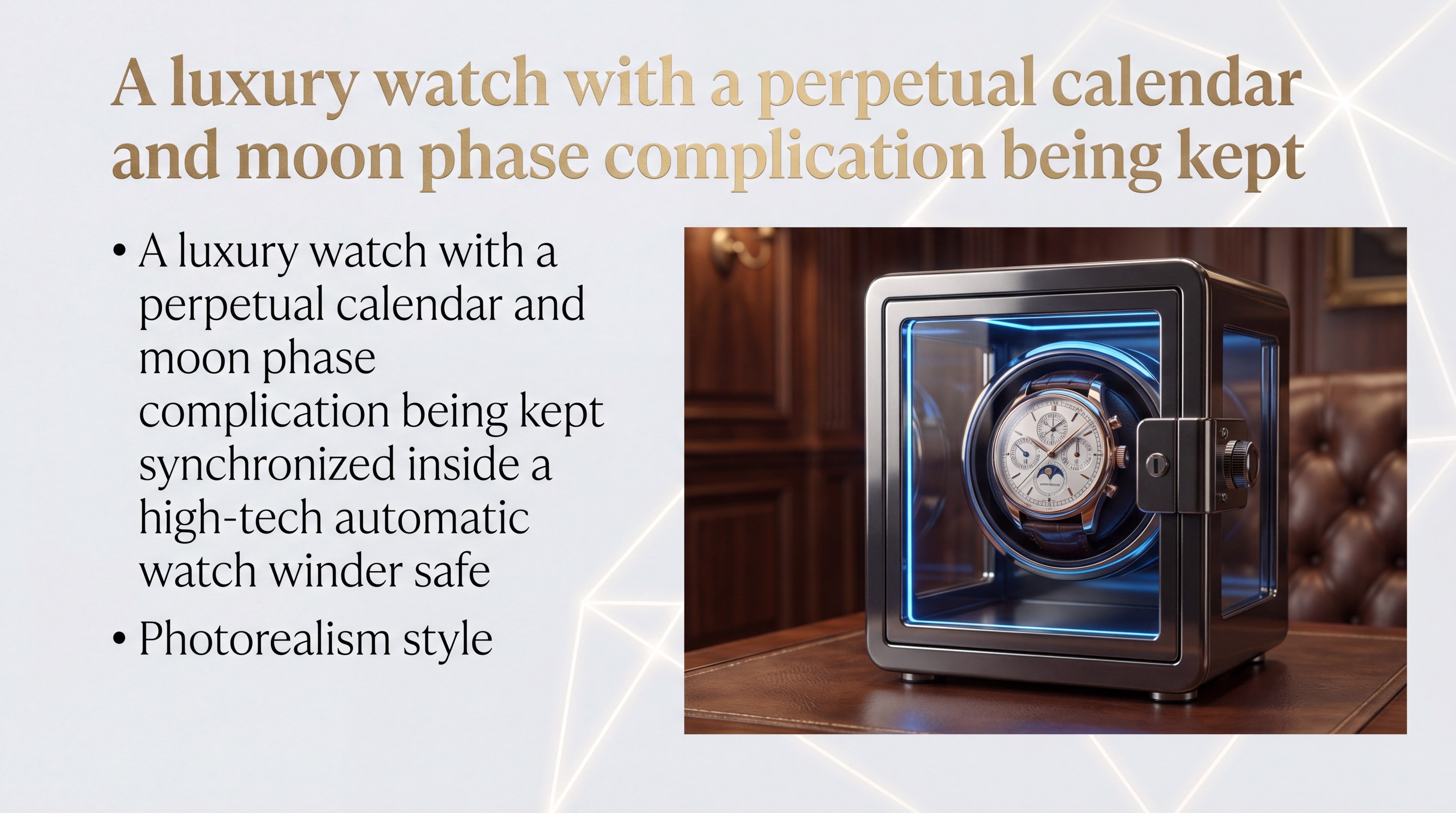
An automatic watch winder safe is vital for calendars because it ensures that complex complications, such as moon phases and perpetual calendars, stay perfectly synchronized without requiring tedious manual resets. For high-complication watches, a stop in motion means a lengthy and risky recalibration process.
Managing Perpetual Complications
Setting a perpetual calendar manually is a daunting task that often requires professional assistance if you miss the correct sequence. You can discover how to sync 12 perpetual calendars using a 12 watch winder safe to master this specific logistical challenge.
- Daily rotation keeps day, date, and month gears aligned.
- Moon phase accuracy is preserved over years of operation.
- The risk of jamming the calendar mechanism during manual shifts is eliminated.
Preservation of Complication Gears
Complication gears are often smaller and more delicate than the main timekeeping gear train. By keeping them in motion, you ensure that the springs and levers responsible for the “date jump” don’t become stiff or misaligned.
The kicker is:
If a perpetual calendar stops, you might have to wait months for a manufacturer-specific tool just to reset the year indicator correctly.
Key Takeaway: Complication watches are “use it or lose it” machines; keeping them wound is a requirement for their functional longevity.
| Complication | Complexity Level | Winder Impact |
|---|---|---|
| Standard Date | Low | Convenience only. |
| Annual Calendar | Medium | Protects monthly gear jumps. |
| Perpetual Calendar | High | Critical for gear synchronization. |
Automated winding maintains the intricate choreography of calendar wheels that only interact once every few years.

Does an automatic watch winder safe help maintain accuracy?
An automatic watch winder safe helps maintain accuracy by providing a consistent level of power to the mainspring, which ensures the balance wheel oscillates with high amplitude. When a watch’s power reserve drops, the “beat” of the watch can slow down or become erratic, leading to timing deviations.
Maintaining Optimal Amplitude
Amplitude refers to the degree of rotation in the balance wheel; a healthy watch usually oscillates between 270 and 315 degrees. You ensure your watch stays within its “sweet spot” by keeping the mainspring wound to a consistent 70-90% capacity.
- Consistent power leads to a more stable beat rate.
- Avoids the “isochronism” issues found in nearly depleted springs.
- Ensures the watch is ready to wear with chronometer-level precision.
Environmental Stability
By housing your watches in a safe, you protect the delicate hairspring from extreme temperature fluctuations that can cause metal expansion or contraction. This stable environment is just as important for accuracy as the winding motion itself.
Believe it or not:
A watch that runs consistently in a controlled environment will often show less daily deviation than one subject to the chaos of a drawer.
Key Takeaway: High amplitude is the hallmark of a healthy movement; a winder keeps that energy level high and stable.
| Accuracy Factor | Depleted Spring | Winder-Maintained |
|---|---|---|
| Amplitude | Low (Erratic timing) | High (Stable timing) |
| Beat Error | Increased risk | Minimized |
| Daily Deviation | High | Low |
Stable kinetic energy prevents the balance wheel from slowing down as the mainspring loses its tension.
Is an automatic watch winder safe for long-term storage?
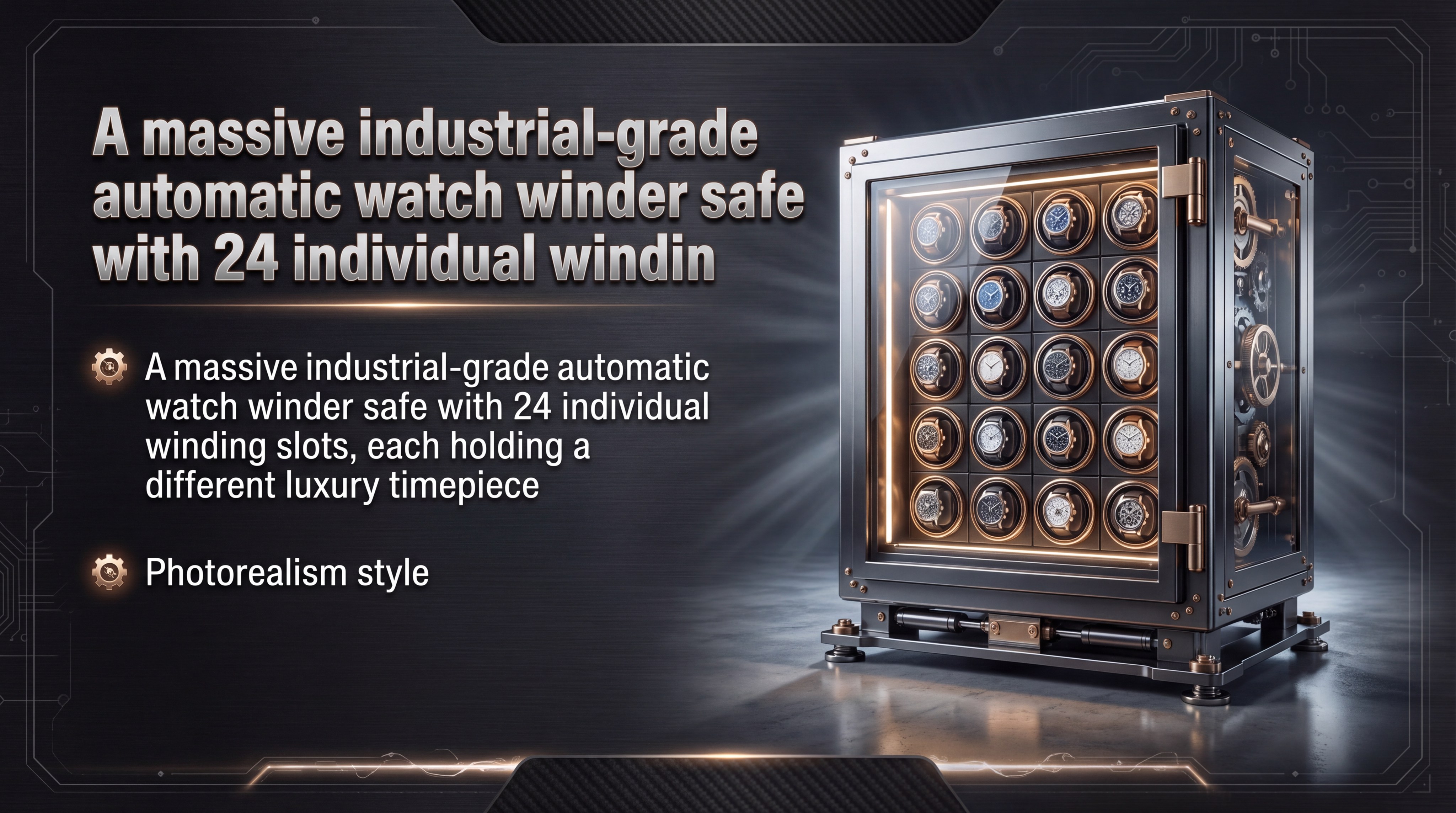
An automatic watch winder safe is the superior choice for long-term storage because it combines mechanical maintenance with industrial-grade physical security to protect your assets from both rust and robbery. Traditional storage boxes offer no protection against theft and do nothing to keep the movement healthy during months of non-use.
Security and Centralization
When you store your watches in a high-security vault, you are protecting more than just the gears; you are safeguarding your financial legacy. You can research how to centralize your collection with a 12 watch winder safe to optimize your home security layout.
- Biometric or digital locks prevent unauthorized access.
- Fireproof and waterproof materials protect against disasters.
- Organized winding slots allow you to view your entire collection at once.
Humidity and Dust Control
Modern safes are often sealed or climate-controlled, which is vital for preventing the gaskets from drying out and the dial from fading. You stop dust from entering the case through the crown by keeping the watch in a pristine, enclosed environment.
The kicker is:
Many collectors lose more value to theft than to mechanical wear; a safe addresses both risks simultaneously.
Key Takeaway: Storage is not just about where the watch sits; it is about the environment and security that surround it.
| Storage Method | Security Level | Mechanical Care |
|---|---|---|
| Jewelry Box | Low | None |
| Standard Safe | High | None |
| Winder Safe | High | Active Maintenance |
Combining a heavy-duty steel enclosure with precision winding motors creates the ultimate preservation chamber for high-value watches.

How does an automatic watch winder safe protect gaskets?
An automatic watch winder safe protects gaskets by maintaining internal movement that keeps seals supple and by reducing the friction-heavy handling required for manual resets. Rubber and silicone gaskets rely on a thin film of lubricant to stay airtight, and consistent motion helps distribute these protective coatings.
Supple Seals and Pressure Resistance
A gasket that sits in one position for years can become compressed or “set,” losing its ability to spring back and maintain a seal. You keep the internal environment dynamic by ensuring that pressure and lubricant are regularly refreshed across the sealing surfaces.
- Motion prevents the internal “drying out” of rubber components.
- Reduced crown usage prevents the tearing of the O-ring seals.
- Keeps the case back seal from adhering to the metal through stagnation.
Avoiding Environmental Exposure
The high-quality enclosure of a safe keeps your watches away from UV light and ozone, both of which are the primary enemies of rubber longevity. You extend the life of your water-resistance rating by keeping these materials in a dark, stable atmosphere.
Here is the deal:
Replacing a set of hardened gaskets often requires a full service because the watch must be pressure-tested afterward.
Key Takeaway: Gasket health is the “front line” of watch protection; keeping them supple is much cheaper than fixing a flooded movement.
| Gasket Enemy | Impact | Winder/Safe Solution |
|---|---|---|
| UV Light | Cracking and brittleness | Opaque safe walls |
| Stagnation | Compression set | Regular mechanical motion |
| Friction | Tearing (at the crown) | Reduced manual setting |
Supple gaskets ensure that moisture and microscopic dust never breach the movement’s interior.

Can an automatic watch winder safe lower service costs?
An automatic watch winder safe can lower your long-term service costs by significantly extending the intervals between professional overhauls and reducing the need for expensive replacement parts. By preventing the accumulation of metallic “dust” from friction and keeping oils fresh, you ensure that a standard service remains a cleaning rather than a repair.
Extending Service Intervals
Most manufacturers recommend a service every 5 to 7 years, but a well-maintained watch on a winder can often push that limit with less risk. You avoid the “emergency” repairs that occur when a dormant watch is forced back into service and snaps a weakened spring or gear.
- Fewer part replacements are needed during routine overhauls.
- Reduced wear on the winding rotor bearing through consistent motion.
- Maintains the integrity of the escapement, which is the most expensive part to replace.
Reducing Repair Complexity
When you bring a watch in for service that has been running perfectly on a winder, the watchmaker spends less time troubleshooting. You can check the Jimbo Safes product page to find a system that matches your collection’s specific TPD (Turns Per Day) needs to optimize this maintenance.
Think about it:
A $2,000 service bill is often high because of the cost of five or six individual gears that wore down due to lack of oil.
Key Takeaway: Proactive mechanical maintenance is always more cost-effective than reactive horological repair.
| Expense Source | Cost Without Winder | Cost With Winder |
|---|---|---|
| Part Replacement | High (due to friction) | Low (due to lubrication) |
| Crown Tube Repair | Frequent | Rare |
| Timing Calibration | Complex | Simple |
Reducing internal friction prevents the shedding of microscopic metal flakes that act as abrasives within the movement.
What makes an automatic watch winder safe for daily use?
An automatic watch winder safe is perfect for daily use because it allows you to rotate through your collection effortlessly while maintaining the “grab-and-go” readiness of every piece. For the modern collector, time is the most valuable luxury, and a winder eliminates the five-minute ritual of setting a watch every morning.
The “Grab-and-Go” Lifestyle
You should be able to pick your watch based on your attire, not based on which one is currently running. A winder ensures that your entire rotation is set, synchronized, and ready for your wrist the moment you open the vault.
- Eliminates morning frustration with stopped watches.
- Keeps your “daily driver” and your “weekend pieces” equally ready.
- Allows you to transition from a sports watch to a dress watch in seconds.
Professional Aesthetic and Organization
A high-end safe acts as a museum-quality display for your collection, turning your mechanical investments into a centerpiece of your home. You gain peace of mind knowing that while they are being displayed, they are also being maintained and protected.
The kicker is:
A collection you can’t easily wear is a collection you can’t fully enjoy; a winder brings your watches back to life.
Key Takeaway: Convenience and care are not mutually exclusive; a winder provides the best of both worlds for the active collector.
| Routine Aspect | Without Winder | With Winder Safe |
|---|---|---|
| Setup Time | 5-10 Minutes | 0 Minutes |
| Security Risk | High (on dresser) | Zero (inside vault) |
| Enjoyment | Limited by hassle | Maximum flexibility |
Daily rotation within a secure environment ensures your watches are as ready for a boardroom meeting as they are for a black-tie event.
Is every automatic watch winder safe for your collection?
An automatic watch winder safe must be chosen based on its ability to offer customizable settings, as a one-size-fits-all approach can actually lead to unnecessary wear. You must ensure your winding system can handle the specific TPD and directional requirements of your various watch brands to ensure maximum longevity.
Understanding Customization
Not all movements are the same; some require clockwise rotation, while others need counter-clockwise or bi-directional motion.
- Check your watch manufacturer’s manual for TPD specs.
- Select a winder with independent motors for each watch.
- Ensure the safe uses non-magnetic materials to prevent magnetization.
- Verify the quality of the cushions to prevent strap stretching.
- Look for “sleep” cycles that allow the mainspring to relax.
Evaluating Build Quality
A cheap winder with a noisy, low-torque motor can introduce vibrations that are detrimental to your watch. You want a system that operates silently and smoothly, reflecting the same precision as the watches it houses.
Believe it or not:
A low-quality winder can actually magnetize your watch if the motor isn’t properly shielded, causing it to run fast.
Key Takeaway: Your winder should be of the same quality as your watches; don’t put a six-figure collection in a bargain-bin winder.
| Winder Quality | Motor Shielding | Customization |
|---|---|---|
| Budget | None (Risk of Magnetism) | Low/Fixed |
| Professional | High (Safe for movement) | High/Per-Slot |
| Custom Safe | Maximum (Optimal Care) | Infinite |
Precision winding requires a motor that can deliver exact rotation counts without generating electromagnetic interference.
*
Conclusion
Your luxury watch collection represents a fusion of art, history, and mechanical perfection. Letting these timepieces sit idle not only risks their mechanical health through oil stagnation and gasket decay but also places your financial investment at risk from theft. By choosing a professional winding and security solution, you solve the problem of mechanical stagnation while ensuring your horological legacy remains intact for future generations.
At Jimbo Safes, our vision is to provide every collector with the ultimate sanctuary for their timepieces, combining the world’s most reliable winding technology with unyielding physical security. We believe that caring for your watches should be as seamless as wearing them. If you are ready to elevate your collection’s health and security, please contact us today for a personalized quote and expert guidance.
*
Frequently Asked Questions
- Can I over-wind my watch using a winder?
Judgment: No, it is virtually impossible with modern watches. Automatic movements feature a “slipping spring” mechanism that allows the mainspring to slide inside the barrel once full tension is reached, preventing any physical breakage. - What is the best TPD (Turns Per Day) for most watches?
Judgment: Generally, 650 to 800 TPD is the industry standard. Most Rolex and Omega movements thrive at this range, but you should always verify the specific needs of your caliber to ensure optimal amplitude. - How do I know if my watch is clockwise or counter-clockwise?
Judgment: You should consult a reliable brand database or the user manual. While many modern movements are bi-directional, some high-end brands like Patek Philippe often require a specific single direction to engage the winding rotor. - Can I keep my winder running 24/7?
Judgment: It is safe, provided the winder has a “sleep mode.” Quality winders include rest periods in their programming to mimic the natural rhythm of a wrist, ensuring the mainspring isn’t under constant maximum tension. - How do I know if my winder safe is high quality?
Judgment: You must check for motor noise and magnetic shielding. A high-quality unit will be nearly silent during operation and will feature motors that are positioned or shielded so they cannot magnetize the delicate hairspring inside your watch.


